
Return to Play: Rodri Edition - Soft Launch > Heroic Comeback
You guys fancy more of a soft launch or a hard launch?


Welcome back, ladies and gentlemen, to this week’s episode from The Scout Report.
You’ve probably watched City this season and thought: “Rodri’s playing… but something’s just 5–10% off.”
That’s exactly what we’re unpacking today.
Big injuries, and especially ACLs, are never seamless; they take players out of their rhythm. And when your whole job is to be the rhythm, like Rodri in Guardiola’s single pivot, even tiny drops in confidence, rotation speed, or strength show up. So this episode is the injury explanation for what your eyes have already noticed.
We’re diving into something deep-rooted in anatomy: the ACL.
Don’t worry, we’ll get through it. After all, some of you are Manchester United fans; if you can put up with that every weekend, this will be a breeze.
This Week’s Case: Rodri’s ACL Injury
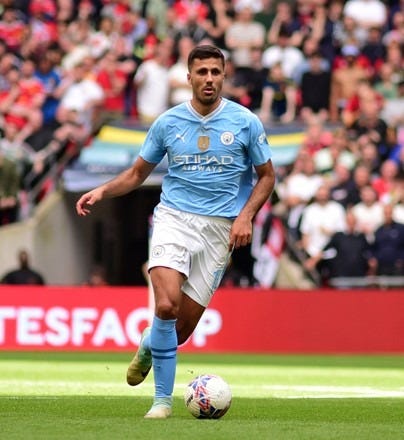
Before we get too far off the rails, let’s focus on our topic: Manchester City midfielder Rodri, who suffered a significant ACL injury at the start of the 2024 season.
What exactly is the ACL?
As I’ve shared before, ligaments are like rubber bands, they must be flexible enough to allow movement but strong enough to maintain tension under stress.
The anterior cruciate ligament (ACL) prevents the tibia (shinbone) from sliding too far forward on the femur (thigh bone). While that sounds simple, it’s far from it. The ACL stabilizes the knee against forward and rotational forces especially during cutting, pivoting, and landing which is vital for various types of athletes not just footballers.
Because these movements generate high loads, the ACL bears tremendous stress, making it essential for both athletic performance and joint stability.
In Football, the ACL Supports:
Explosive movements such as cutting, pressing, and rapid changes of direction.
Quick deceleration and re-acceleration, critical for reacting to opponents and transitioning between phases of play.
Confidence and control in movement- a weakened ACL often leads to reduced agility and slower reactions.
While we could spend days unpacking its importance, I’ll spare you the anatomy lecture. And no, despite being a physio, I still hate seeing players get injured, so no injury clips here.
Instead, here’s a solid visual explanation from Complete Anatomy on how ACL ruptures occur.
Case Study: Rodri (Manchester City / Spain)
What: Right ACL Grade 3 rupture
When: September 22, 2024, vs. Arsenal
How: Twisted awkwardly in a duel with Thomas Partey during a corner
Return: Substituted back into play in May 2025
You might ask, “If he’s already back, why bring this up?”
Fair question. But here’s the counter: Has he really returned?
While Rodri is back on the pitch, it’s clear he hasn’t reached the same form that won him the 2024 Ballon d’Or. So far this season, he’s started only four Premier League matches, played 90 minutes twice, and was last subbed out in the 22nd minute versus Brentford due to hamstring discomfort on October 5th.
So why is returning to form after an ACL injury so hard, even for a world-class athlete?
Why ACL Recovery Is So Difficult
1. Biological Healing vs. Functional Recovery
After reconstruction, the ACL graft(the new ACL) undergoes ligamentization, a remodelling process where it transforms into a ligament-like structure. This can take anywhere from 12–24 months, during which means the graft is weaker and less organized.
Even when it appears fully healed, it may not yet tolerate the same rotational or high-torque stresses as a natural AC,L which is required for a Premier League caliber footballer.
2. Neuromuscular Control & Proprioception Deficits
The ACL contains mechanoreceptors that help the brain sense joint position. After surgery, this feedback loop is disrupted, weakening the brain–muscle connection that controls coordination.
Athletes essentially have to relearn how to move, how to cut, plant, and decelerate. Even minor deficits here can create long-term asymmetries. And that relearning looks great in a controlled setting, but it’s a lot tougher in a match situation - receiving half-turned, defending a counter while backpedalling, planting off the operated leg are all where the little gaps still show up
3. Muscle Atrophy & Strength Imbalances
Even with elite rehab, quadriceps muscle strength deficits of 10–15% are common between the surgical and non-surgical leg. This not only reduces shock absorption of the knee but also disrupts the quad–hamstring balance vital for stability during pivots and sprints.
Beyond muscle size, timing and activation are affected, meaning muscles may not fire correctly in high-speed movements which could very well be the difference of a goal or block.
What the Research Says
A good follow-up thought may be: “How does Rodri compare to other footballers returning from this injury?”:
A 2019 study looked at 51 elite players from UEFA’s top five leagues who suffered complete ACL ruptures between 1999 and 2019. Here’s what they found:
“Overall, 80% returned to play after an ACL rupture, but 12% suffered a second tear. Injured players appeared in fewer games and recorded inferior performances for two seasons post-injury. By the third season, most regained their pre-injury level—except attackers, who continued to decline.”
So yes, most players return, but it often takes 2–3 seasons to fully recover form. And yes, Van Dijk is a freak.
Rodri’s Tactical Demands and Why They Complicate Recovery
Rodri is Manchester City’s central anchor, the single pivot in Guardiola’s system. He maintains structure in possession and defense, dictates tempo under pressure, and shields the back line by intercepting transitions and closing central spaces.
His game relies on rotational control, balance, and precise body positioning, all of which demand a stable and responsive ACL. Even small losses in proprioception or confidence can slow his half-turns, affecting how he receives and distributes under pressure.
In Guardiola’s tightly synchronized system, these micro-deficits can disrupt rhythm, timing, and defensive structure. The result? A player who’s physically back, but still searching for full functional fluency.
Furthermore these team statistics from Opta Analyst demonstrate how important Rodri is to City’s success:
In the Premier League since Rodri joined City in 2019, they’ve averaged 2.37 points per game in matches he plays vs. about 1.90 points per game when he doesn’t
Win rate is roughly 74 % in PL games with Rodri, compared to about 62 % without him.
Final Whistle
If anyone remembers the Old School debate scene with Will Ferrell, yeah, that was me writing this: “I blacked out, what happened?” - (Jared wrote this one, not me).
But if you made it this far, congratulations and thank you. Whether you’re a City fan or not, we’re all rooting for Rodri to return to full strength. His path isn’t unusual; even the best take time.
And please, don’t compare him to Virgil van Dijk, we’ve all accepted by now that he’s not human.
With patience, Rodri will likely find his rhythm again and when he does, the rest of us will be back to complaining that he’s made City too dominant once more.
Thanks for reading The Scout Report. If you enjoyed this post, consider subscribing or sharing as it helps more fans understand the science behind the beautiful game.
Oh, and most importantly, subscribe to Jared Winston ‘The Football Council’ for more cool stuff like this!
 | A guest post by
|
Ian Fray is an interesting example, tore his right acl three times and is somehow still playing professional football.